Connecticut LEND is excited to welcome many special guests on Friday, October 17, 2025.
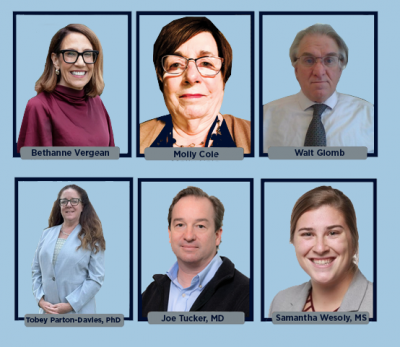
Bethanne Vergean is a Learn the Signs, Act Early Ambassador and Research Associate at the UConn UCEDD. Bethanne has been working in the early childhood field for over 20 years, and has a wealth of expertise on pediatrics, early intervention, public health, and mental health. In 2019, Bethanne was selected to be the Connecticut Learn the Signs, Act Early Ambassador by the American Academy of Pediatrics (AAP) and the Centers for Disease Control and Prevention (CDC). Bethanne’s presentation on Friday will focus on Learn the Signs, Act Early, the CDC’s screening initiative to improve early identification of children with autism and other developmental disabilities.
Molly Cole, Walt Glomb, and Tobey Partch-Davies, PhD, will be speaking to trainees about the Developmental Disabilities Network. Molly Cole is the Executive Director of the CT State Independent Living Council, Walt Glomb is the Executive Director of the CT Council on Developmental Disabilities, and Tobey Partch-Davies, PhD, is the Executive Director of Disability Rights Connecticut.
Joe Tucker, MD is an Assistant Professor of Genetics and Genome Sciences at UConn Health. His presentation will present information on genetics and neurodevelopmental disabilities.
Samantha Wesoly, MS is the Associate Program Director for Genetic Counseling at the Institute for Systems Genomics at the University of Connecticut. Samantha’s presentation will provide a discipline perspective of genetic counseling and will supply trainees with information on the characteristics and the role of the geneticist and the genetic counselor.